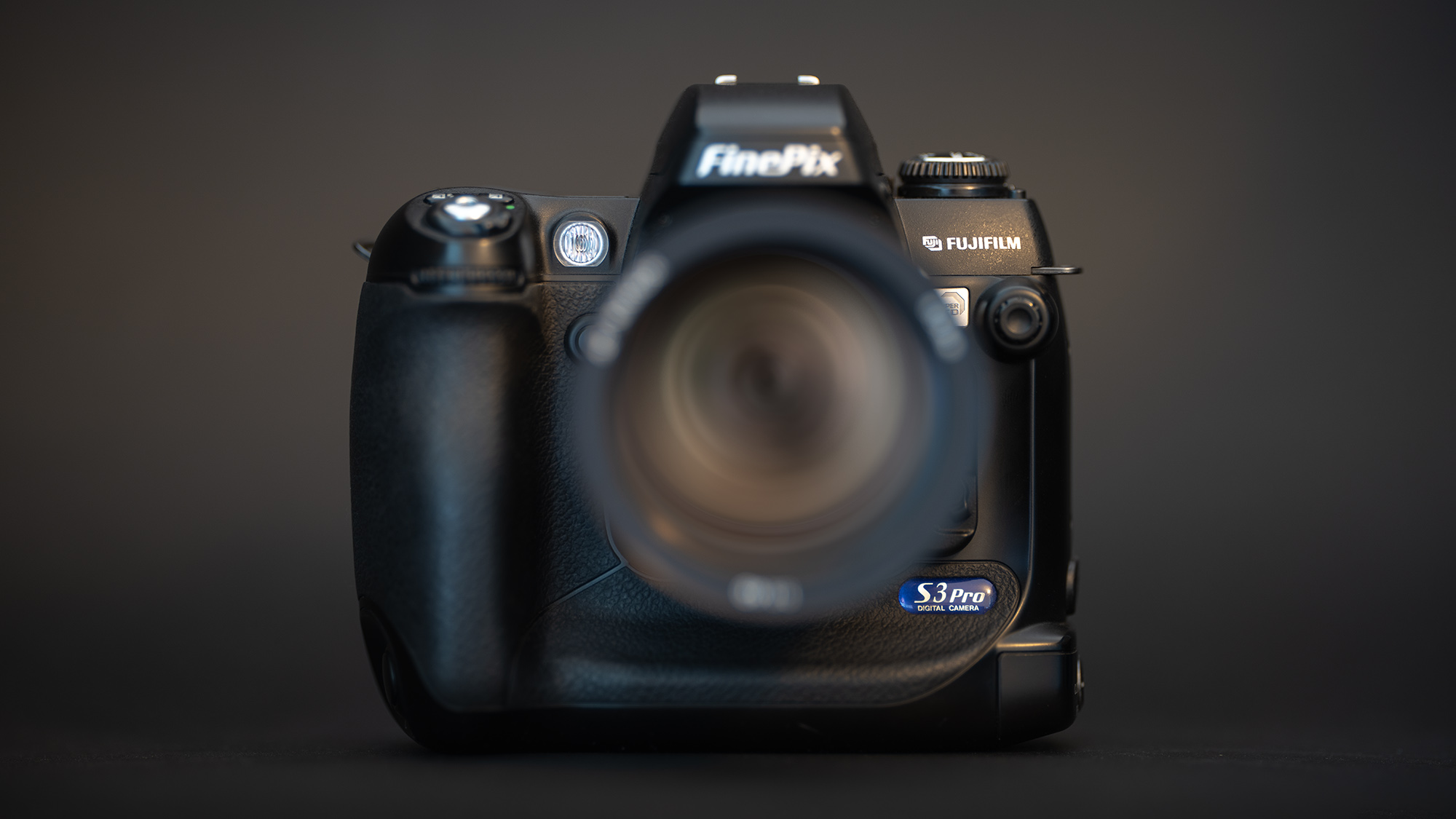
Fujifilm S3 Pro
I bought the Fuji S2 Pro new back in 2002. I had a compact digital Fuji (6900z) a year earlier and being used to SLRs I was desperate for better controls and image quality. It was a solid camera for the time, but it had a few glaring issues that the S3 Pro aimed to address. With twenty years of hindsight, how does the S3 Pro stack up?…
Specifications
Date:
$ (inflation):
Sensor:
Resolution:
Burst:
DR Stops:
Sync:
SS:
AF points:
Video:
Live-View:
ISO:
OVF:
LCD:
Memory:
Data Cable:
Weight:
Battery:
2005 (Feb)
$2,500 ($4,263)
APS-C (1.5x) CCD
6mp
1.4fps / 7 RAW
8.5 (12bit)
1/180th
30s – 1/4,000th
5 (5%)
No
Yes
100 – 1600
0.8x / 94%
2.0” / 235k / Fixed
xD / CF
USB / Firewire
930g
4x AA
Market
Although the S3 Pro is good upgrade from the previous model and has a very interesting sensor, it was always going to be compared to Nikon’s digital SLRs. Sharing a lens mount with Nikon made it easy to switch between the two brands and that mostly hurt Fuji. Kodak had already learned this lesson the hard way, by 2005. Unfortunately, Nikon was about to release an absolute banger of a camera, with the D200, in the same year and for much less money. Fuji ended using the D200 for their next model (S5 Pro), but it would mark the end of their partnership with Nikon, in 2007.

Ergonomics & Build
The original Fuji S1 Pro was built around a Nikon F60, a low end film SLR, that made it feel like a budget version of a Kodak digital SLR. Fuji upgraded this to slightly better F80 for the S2 pro, but it kept the horrible dual-battery setup. Both of these models were tall, plasticy feeling frankencameras that looked like they should have a vertical grip, but didn’t. Although the S3 Pro kept the rather lacklustre F80 body as a base, they did a much better job with the ergonomics. The rubber grip is much more comfortable, you get a proper vertical grip and they managed to keep it quite a bit smaller than the pro Nikon bodies too (D1, or D2H by this point). Better yet, they reduced the battery situation to a single setup. Just four AA batteries for the entire camera. Although that’s not as cheap or convenient as the typical rechargeable Li-Ion packs, but I will steelman that decision and point out that you can just pop into a corner store and buy replacements.
The button arrangement on the S3 Pro is much like the previous model and is again stuck working around the awkward Nikon F80 film camera functionality, although the vertical shutter is a nice addition. That being lockable is very useful considering the shorter grip means you’re more likely to accidentally press it while holding it in landscape mode. The custom menu being a set of numbers with states reminds me of the Nikon D1 menu, that being a holdout from the Nikon F5’s system. It’s nice that the functions are explained on the rear LCD here, but why not just have them all in the menu? Weird!

Image Quality
Like many of the previous sensors, the S3 Pro continued to double the resolution from the offset photosites. This time however they used two sets of six megapixel grids, one for the shadows and one for the highlights.
Fujifilm DSLRs originally interpolated the resolution up to double the native pixels, but if you bring them into modern software it doesn’t do that any more. The S3 Pro used two six megapixel sensors combined, one for the normal lighting and another for the highlights. This means it technically was twelve megapixels, but it’s only used to increase the dynamic range of the image, rather than resolution.
The colours are nice and vibrant here, as everything was from this time period. I used to think that was related to the CCD sensors, but you will find it on CMOS ones up to around 2011 too. It’s something that I am still trying to replicated with custom colour profiles on modern cameras, but here you will get it by default. For people not comfortable with tinkering, these old cameras represent the easiest way to get these really fun colours.

Battery
The Fujifilm S1 & S2 Pro used four AA batteries for the digital components and two CR123a batteries for the film section (same as the Nikon F80). Fortunately many complaints from users caused them to reduce this complexity down to just the four AA batteries. This was much better, but it was still expensive compared to the rechargeable Lithium Ion batteries that everyone else used. The only benefit here is that you could pop into pretty much any corner store and buy replacements. Fortunately that is still true today because I actually needed to do that to capture the above and below images. What I am not so impressed with is the fact that you can burn through these batteries in just over 100 shots! That is absolutely mental!

Speed
When shooting RAW, the burst speed of the S3 Pro is only 1.4 frames per second (fps) and only for four frames (if you’re using compact flash cards). This was terrible performance, even back in 2005. It was worse than that of the S2 Pro, three years earlier and that was already bad because of the resolution doubling. The dual sensitivity sensors was actually pretty clever, but when you’re paying four times the memory and speed cost for something that didn’t always show up in your photos, it can be a really tough sell. A few months later, the Nikon D200 was able to capture nearly double the resolution at 5 frames per second and for 21 frames! Considering the Nikon was a dedicated DSLR design with a full magnesium professional body you might expect that to cost three times as much, but it actually cost over 30% less!
Shutter
The flash sync speed of the Fujifilm S3 Pro has been bumped up to 1/180th. This is a welcome boost from the 1/125th of the S2 Pro and F80film camera that it was based on, but it still feels rather lacklustre. It now matches the Nikon D100 spec, which was fine for a few months, but again, when Nikon brought the D200 out later in the year it would raise the bar massively in that area too. The D200 used a professional grade 1/1250th shutter, making the S3 Pro feel like a cheap toy.

Conclusion
I switched to Nikon after the Fujifilm S2 Pro, but part of my was very curious about the S3 Pro and using it now I think it could have been a very interesting camera to have had back in the day. This was about the most image quality you could squeeze out of a six megapixel sensor. I look at it now and am really impressed. Most of the issues I see are lens or autofocus related. When you do get a clean shot from it, the images can really shine!
Coming out the same year as the Nikon D200 did not help the S3 Pro, as it needed to be less than half the price to realistically compete. The D200’s resolution was better, even if the dynamic range wasn’t quite as good, but it’s the speed and file size that put it lightyears ahead of the Fuji at the time. Going back to use these cameras today, this is not so much of an issues as you’re not going to be choosing whichever has the ultimate quality. The D200 is a very nice camera, but the S3 Pro is a little more interesting due to its dual sensitivity sensor.
Despite not having the same chassis quality as the D200, the S3 Pro does still feel very well put together and considering that it weighs about the same while having a very nice integrated vertical grip, it’s a very interesting camera.